
10 Mindset Shifts For Artists That Matter More Than Technical Skill
I was in second grade. I remember being handed a map of Louisiana, a box of crayons, and feeling pure joy; mixing colors, experimenting, letting my intuition guide me.
When I proudly showed my teacher the finished piece, her face fell. Not only had I not colored within the lines, I had "mixed the colors incorrectly." She was so alarmed that she called a meeting with my parents, telling them she was worried something might be developmentally wrong with me.
I already carried the weight of being born with strabismus and rheumatic fever, and doctors had warned my parents that I might face challenges as I developed. So, unfortunately, the teacher's concerns fed directly into my parents' deepest fears.
I also internalized this message instantly: I am not an artist. I am too messy. There's something wrong with me. For years, I believed this about myself. Often too afraid to pick up drawing or coloring instruments again, despite them also being such a source of joy and peace for me.
Here's the thing, I was wrong and so was my teacher. It took me years of self-discovery, therapy, and healing to fully internalize this. And if you've ever felt that same shame about your "technique," you might be wrong too.
What's ironic and even sad in some ways is that the contemporary art world, from MFA programs, like the one I attended at UC Berkeley, to top-tier galleries and museums, operate on a completely different metric than the "good drawing" standard so many of us were taught in grade school.
Once you move past the beginner level, technical mastery becomes secondary to something far more valuable: your ideas, your research, your intuition, your joy, and your ability to build a world only you can build. If only I had understood this as a young child.
Unlearning The Lies
This is what has inspired me to create this list. To offer an alternative to the notion that it is only "good skill" that deems an artwork worthy of being "important" or that makes someone an "artist" or not.
Here are 10 mindset shifts and concrete studio exercises to help you stop agonizing over your technique and start building your Art Vision, one artwork, one small shift, at a time.
1. Shift from "Object-Making" to "World-Building"
The Mindset: Stop trying to paint the perfect bowl of fruit. Instead, ask: What universe am I creating? Look at the immersive, boundary-dissolving work of Lizzie Fitch and Ryan Trecartin, they built an entire sculptural theater inside Morán Morán gallery using weatherboard, carpet, sofas, and chaotic video, refusing any rule about what materials an artist "should" use. And if you've never seen any of Ryan Trecartin & Lizzie Fitch's videos, I suggest you start here.
The Takeaway: Curators aren't looking for standalone pretty objects. They are looking for a cohesive, fascinating universe that only you can build.
The Studio Practice: Try and take a couple of your artworks and imagine what kind of universe they live in. What are the rules of this universe? Who inhabits it? Are there planets? Stars? Black holes? What's different about your universe? What makes it uniquely you? Write about this or allow it to inspire an artwork.
2. Shift from "Blank Canvas" to "The Archive"
The Mindset: You don't have to invent everything from scratch. Your cultural heritage, family photos, and personal history are incredibly potent materials. Bring these into your artwork directly through collage, by drawing or painting them, making them a part of your video or dance work. Or let these archives inspire you to imagine new possibilities or connections between histories and spaces.
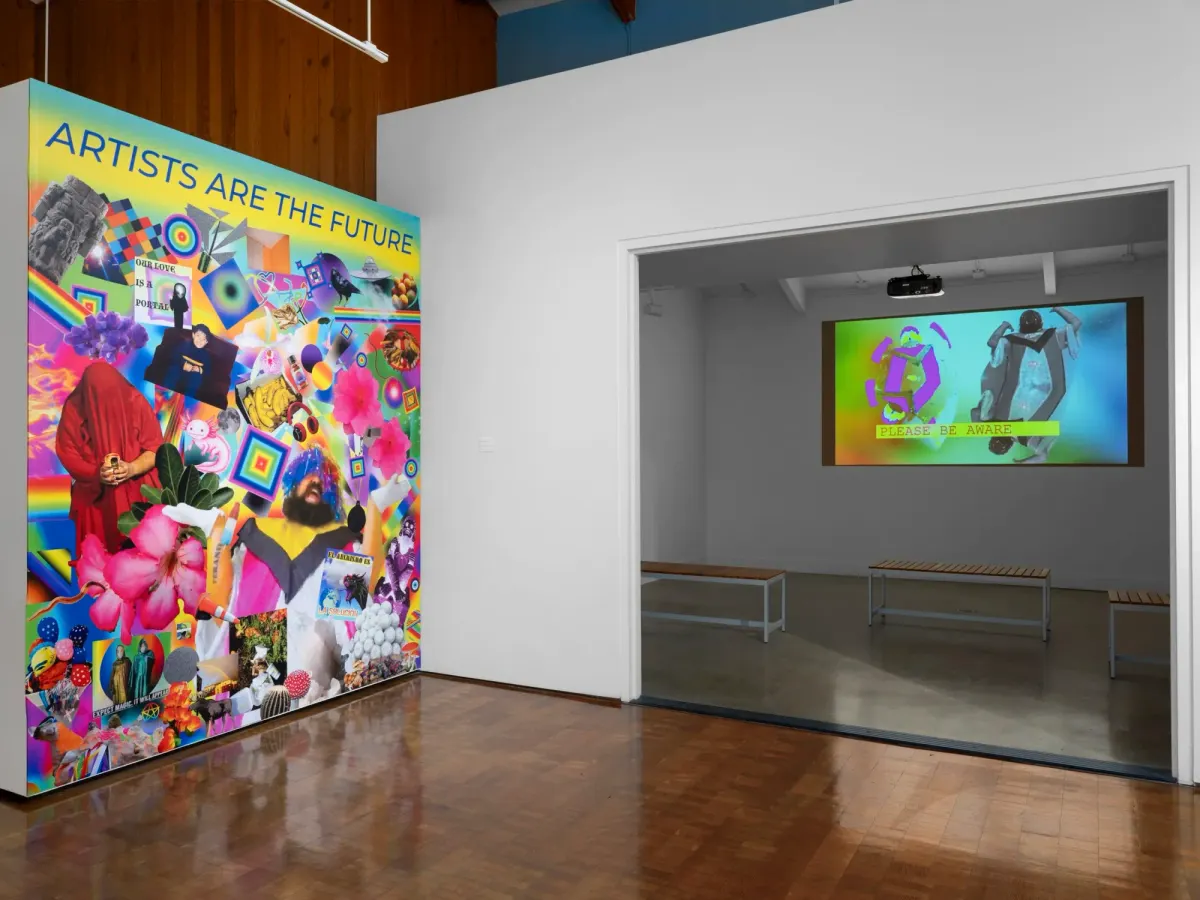
The Takeaway: Sadie Barnette's How to Fly at CAAM pulls directly from her own family archive: old photos, a cousin's birthday cake, ephemera, blown up against a giant rainbow backdrop. Technique is just how you manipulate your materials; true vision is recognizing that your lived experience is the material.
The Studio Practice: Think of an archive you're interested in exploring. It could be one of your childhood or a family members, or an artist, institution, or historic person you admire. Spend some time exploring this archive, take photos, notes, see what it emotions, sensations, or thoughts it elicits in you. Create an artwork inspired by the archive. What aspects of the archive end up in your art? What feels important about sharing this aspect? Do you notice it's easier to be vulnerable or more distanced when it comes to exploring archives in your art?
3. Shift from "Aesthetic Perfection" to "Sacred Understanding"
The Mindset: Art doesn't have to be visually "flawless." It can be raw, messy, and utilitarian in a spiritual or emotional sense. It can create a feeling instead of portray a visual message. Not all feelings are pristine, easy to understand, or digest. Some spiritual messages are contradictory, unnerving, and paradigm shifting.
The Takeaway: Guadalupe Maravilla's sound sculptures at the Hammer Museum are built from gong, steel, cotton, loofah, and objects collected while retracing his own migration route from El Salvador. When you view your art as a spell or a healing instrument, the concept becomes the medium. The energy behind it matters more than the polish.
The Studio Practice: Is there an existential or spiritual truth or idea that's been eating away at you? Or one you find uniquely fascinating or disturbing? What emotions does this bring up for you? How does it feel to share about it with others or to bring it into your art? Create an artwork inspired by this process.
4. Shift from "Specializing" to "Mutating"
The Mindset: The old world tells you to pick one medium and master it. The contemporary art world rewards the weirdos and multi-passionates who blend disciplines and explore outside their comfort zones.
This tracks with actual art historical analysis: scholars point to Lawrence Weiner's 1968 declaration that "the artist may construct the piece, the piece may be fabricated, the piece need not be built" as a pivotal moment when ideation began replacing manual skill as the primary criterion of artistry. This is also basis of the conceptual art movement of the 1960s and 1970s.
The Takeaway: Artwork does not need to be created physically to exist. Sometimes ideas are all it takes.
The Studio Practice: Inspired by Yoko Ono's "Instruction Drawings", spend some time in your studio "creating" artworks that exists as poems, text, or ideas written into verse. What does this open up in your practice? How is this limiting or freeing? Does it feel satisfying to "make art" in this way? Why or why not?
Want some more studio exercises and tools I use to put these mindset shifts into practice? Join the Mutant Magic paid tier for $11/month to unlock the final 6 mindset shifts, including the most important thing I believe curators want to see in your practice.